
Affiliation: RSBM
Email: pengchengshi@biotechrs.com; pcspc9@gmail.com
Abstract
Multivitamin products are increasingly formulated to deliver multiple micronutrients in a single dosage form. However, combining vitamins and minerals is not a simple matter of summation. Chemical instability, physical incompatibility, bioavailability interference, and manufacturing constraints frequently undermine product quality and shelf life. These challenges are amplified in Oral Disintegrating Films (ODFs) and other low-mass dosage forms, where space, moisture sensitivity, and uniformity requirements are stringent. This paper proposes a structured compatibility checklist for combining multivitamins, integrating chemical, physical, biopharmaceutical, and process-related considerations. The framework is intended to guide rational multivitamin design that is stable, manufacturable, and clinically meaningful.
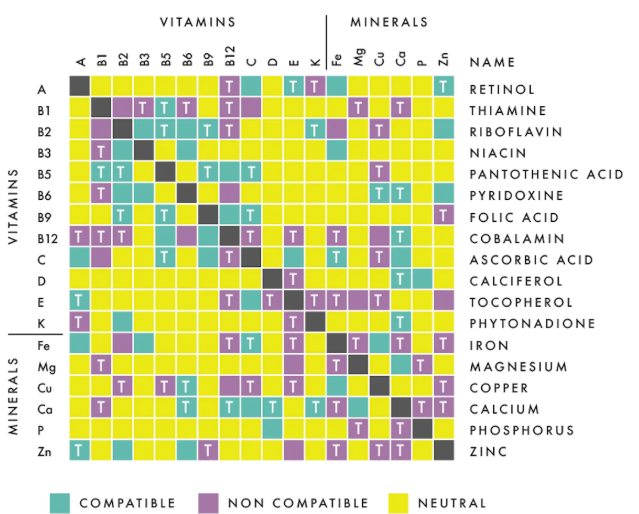
Introduction
Multivitamin formulations are among the most common yet technically complex nutraceutical products. While individual vitamins may be stable and effective on their own, combining them often introduces degradation pathways, absorption interference, or manufacturing failures [1].
In thin-film and other precision dosage forms, the margin for error is small. High surface area, hygroscopic excipients, and low unit mass magnify incompatibility risks that might be tolerable in tablets or capsules [2]. This paper addresses a fundamental formulation question: Which vitamins can be combined, under what conditions, and with what safeguards?
Methods
A compatibility-oriented formulation analysis was conducted using peer-reviewed literature, pharmacopeial data, and industrial multivitamin manufacturing experience. Vitamins and minerals were evaluated across four dimensions: chemical stability, physical compatibility, bioavailability interaction, and process feasibility. These dimensions were organized into a practical checklist intended for early-stage formulation decision-making [3].
Dimension 1: Chemical Compatibility
Oxidation Sensitivity
Certain vitamins—particularly vitamin C, vitamin A, and some B vitamins—are highly sensitive to oxidation. When combined with trace minerals (e.g., iron, copper), oxidative degradation accelerates significantly [4].
Checklist items:
Are antioxidants required?
Are catalytic metal ions present?
Is oxygen exposure minimized during processing and storage?
pH-Dependent Stability
Vitamins differ markedly in their optimal pH stability range. For example, vitamin C degrades rapidly at neutral to alkaline pH, while some B vitamins are unstable under acidic conditions [5].
Checklist items:
Do vitamins share a compatible pH stability window?
Can microenvironmental pH be controlled through excipients?
Dimension 2: Physical Compatibility
Hygroscopicity and Moisture Interaction
Many vitamins (e.g., B-complex vitamins) are hygroscopic. When combined, moisture uptake can increase non-linearly, leading to caking, degradation, or film softening [6].
Checklist items:
What is the combined moisture sorption profile?
Is residual moisture controlled and justified rather than minimized blindly?
Solid-State Interactions
Direct contact between certain vitamins can promote degradation through solid-state reactions, even without moisture.
Checklist items:
Is physical separation (e.g., layered structures) required?
Are protective carriers or encapsulation needed?
Dimension 3: Bioavailability and Functional Interaction
Competitive Absorption
Some minerals compete for the same transport pathways (e.g., calcium, magnesium, iron, zinc). Combining them may reduce net absorption despite higher nominal doses [7].
Checklist items:
Are absorption pathways shared or competitive?
Is dose timing or separation preferable?
Synergistic vs Antagonistic Effects
Certain vitamin combinations are synergistic (e.g., vitamin D and calcium), while others may inhibit each other’s effectiveness.
Checklist items:
Is the combination evidence-based or marketing-driven?
Are claimed benefits supported by interaction data?
Dimension 4: Process and Dosage-Form Feasibility
Dose Density Constraints
In ODFs and other low-mass formats, total achievable loading is limited. Combining too many vitamins often forces under-dosing or compromises film integrity [8].
Checklist items:
Is the target dose realistic for the chosen dosage form?
Can area or thickness adjustments compensate without harming performance?
Uniformity and Distribution
Different particle sizes, densities, and solubilities complicate uniform distribution, increasing the risk of content non-uniformity.
Checklist items:
Are all ingredients compatible with the same mixing and casting process?
Is additional homogenization or particle engineering required?
Measures
Multivitamin compatibility is evaluated using the following indicators [9,10]:
Assay and degradation over time
Moisture uptake and stability testing
Content uniformity
Dissolution and release behavior
Mechanical and visual integrity (for films)
These measures provide early warning of incompatibility before full-scale commercialization.
Results
Application of the compatibility checklist consistently reduces late-stage reformulation and stability failures. Formulations that limit ingredient count, group chemically compatible vitamins, and employ structural or process-based separation strategies show superior stability and manufacturability. Conversely, “kitchen-sink” multivitamin designs exhibit higher degradation rates and poorer dose reliability [11].
Discussion
The primary misconception in multivitamin formulation is that consumer demand for “more ingredients” should dictate design. In reality, technical compatibility and bioavailability should define feasible combinations. Especially in ODFs, fewer well-chosen vitamins often outperform complex blends in both performance and stability.
A checklist-based approach shifts formulation from trial-and-error to structured risk management, saving time and cost while improving product credibility [12].
Conclusion
Combining multivitamins requires more than ingredient aggregation; it demands systematic compatibility assessment across chemical, physical, biopharmaceutical, and process dimensions. The compatibility checklist presented in this paper provides a practical tool for designing multivitamin products that are stable, effective, and manufacturable. By respecting compatibility constraints early, developers can create multivitamin formulations that deliver real value rather than superficial complexity.
References
Ball GFM. Vitamins in Foods. CRC Press; 2006.
Fu Y et al. Expert Opin Drug Deliv. 2004;1(4):673–690.
Cilurzo F et al. Eur J Pharm Biopharm. 2008;70(3):895–900.
De Man JM. Principles of Food Chemistry. Springer; 1999.
Gregory JF. Adv Food Nutr Res. 1996;40:1–33.
Rowe RC, Sheskey PJ, Quinn ME (eds.). Handbook of Pharmaceutical Excipients. Pharmaceutical Press; 2009.
Institute of Medicine. Dietary Reference Intakes. National Academies Press; 2006.
Preis M. J Pharm Pharmacol. 2013;65(2):157–170.
USP <905> Uniformity of Dosage Units.
USP <701> Disintegration Test.
Keshari R, Keshari S. J Drug Deliv Ther. 2014;4(4):1–7.
Preis M. Drug Dev Ind Pharm. 2013;39(7):1049–1057.