Author: Sihan Meng, Leyu Zhu, Pengcheng Shi
Affiliation: RSBM
Email: pengchengshi@biotechrs.com; pcspc9@gmail.com
Abstract
Fast-dissolving vitamin films have emerged as a consumer-preferred format within the nutraceutical market, combining convenience, rapid onset, and pleasant user experience. Unlike traditional tablets and capsules, vitamin films dissolve quickly in the oral cavity, eliminating the need for water and reducing swallowing discomfort. This paper examines the formulation strategies, manufacturing methods, and quality measures that contribute to high consumer acceptance of fast-dissolving vitamin films. Results indicate that optimized film composition and controlled processing can deliver consistent performance while meeting sensory and scalability expectations.
Introduction
Consumer demand for convenient and enjoyable vitamin supplementation has increased significantly in recent years. Tablets and capsules, while effective, often suffer from poor compliance due to swallowing difficulty and delayed perceived effects. Fast-dissolving vitamin films address these issues by offering rapid dissolution, ease of use, and flexible dosing [1,2]. However, consumer preference is strongly influenced not only by dissolution speed but also by taste, mouthfeel, and consistency. This paper explores how these factors can be systematically addressed through formulation and manufacturing design.
Methods
Consumer-Oriented Formulation Design
Vitamin films were formulated using rapidly hydrating, food-grade polymers selected for neutral mouthfeel and minimal residue. Sweeteners and flavoring systems were incorporated to mask vitamin bitterness while maintaining rapid disintegration [3].
Film Manufacturing Process
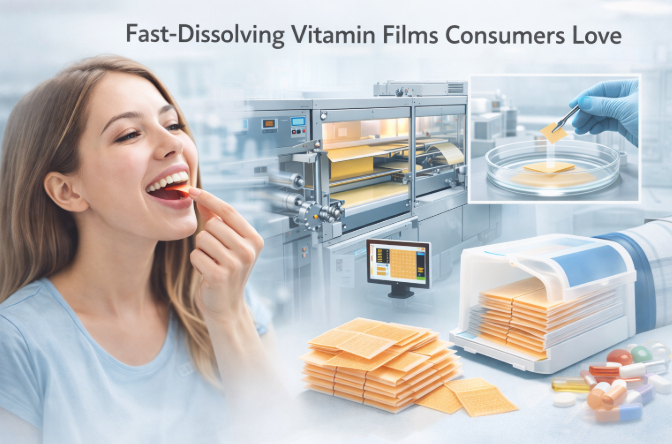
Films were produced using solvent casting and continuous drying under controlled temperature and humidity. Process parameters were optimized to achieve thin, uniform films that dissolve quickly without becoming fragile or sticky [4].
Sensory and Stability Considerations
Formulations were designed to balance fast dissolution with sufficient mechanical strength for handling and packaging. Packaging systems were selected to protect films from moisture and preserve sensory quality during shelf life [5].
Measures
Dissolution Time
Dissolution performance was measured using simulated saliva conditions, recording the time required for complete film disintegration [6].
Sensory Acceptance
Taste, mouthfeel, and aftertaste were evaluated using structured consumer panels to assess overall acceptance and preference [7].
Product Consistency
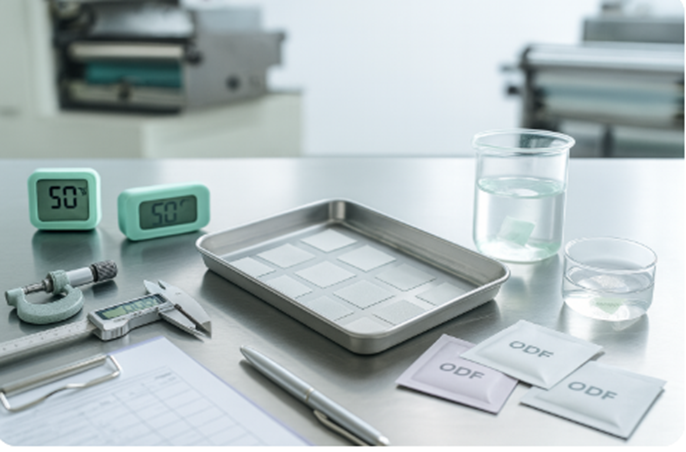
Film thickness, vitamin content uniformity, and visual appearance were measured across batches to ensure consistent consumer experience [8].
Results
Optimized vitamin films consistently dissolved within seconds under simulated oral conditions. Sensory evaluations demonstrated high consumer acceptance, with positive feedback on taste and ease of use. Manufacturing controls ensured uniform vitamin distribution and stable film properties across production batches.
Discussion
The success of fast-dissolving vitamin films lies in aligning technical performance with consumer expectations. Rapid dissolution alone is insufficient if taste or texture is compromised. By integrating formulation science with controlled manufacturing, producers can deliver products that consumers not only accept but actively prefer. These findings highlight the importance of consumer-centric design in nutraceutical film development [9].
Conclusion
Fast-dissolving vitamin films represent a highly attractive dosage form for modern consumers seeking convenience and positive sensory experience. Through careful formulation, precise manufacturing, and robust quality control, vitamin films can achieve rapid dissolution, consistent performance, and strong consumer appeal. This approach supports continued growth and differentiation within the competitive nutraceutical market.
References
Dixit RP, Puthli SP. Oral strip technology: Overview and future potential. J Control Release. 2009;139(2):94–107.
Borges AF et al. Oral films: Current status and future perspectives. J Control Release. 2015;206:1–19.
Preis M, Breitkreutz J. Taste masking and formulation of oral films. Expert Opin Drug Deliv. 2017;14(6):1–12.
Hoffmann EM et al. Manufacturing of orodispersible films: From lab scale to production. Eur J Pharm Biopharm. 2011;78(3):447–455.
Cilurzo F et al. Packaging and stability considerations for oral films. Eur J Pharm Biopharm. 2008;70(3):895–900.
Cilurzo F et al. Fast dissolving films: Technological properties. Eur J Pharm Biopharm. 2008;70(3):895–900.
Stone H, Sidel JL. Sensory Evaluation Practices. Academic Press.
European Pharmacopoeia. Uniformity of dosage units. EDQM, Strasbourg.
Morales JO, McConville JT. Consumer-oriented design of oral films. Eur J Pharm Biopharm. 2011;77(2):187–199.